
DIY or Pro: Who Should Actually Install Your Shower Door in NYC?
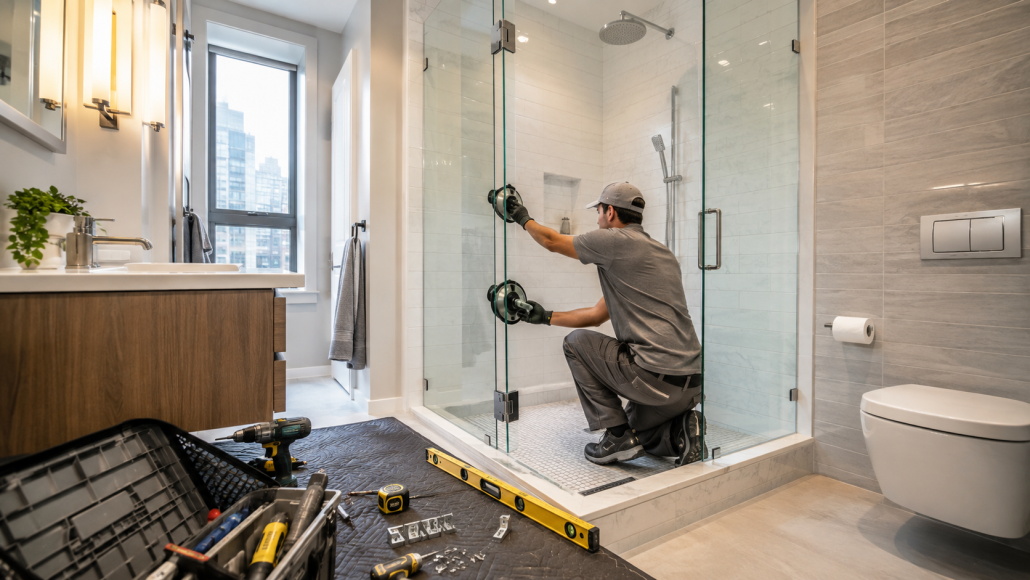
The shower door looked like an easy Saturday project.
A couple of measurements. Some brackets. Silicone around the edges. Done. Then the door started rubbing against the curb.
The bottom gap wasn’t even. Water escaped through one corner every time someone showers. A week later, the hinge was pulling slightly out of alignment, and the homeowner was standing there with a tube of silicone, wondering how a shower door had become a structural engineering problem.
It happens.
Sometimes it’s a DIY project. Sometimes it’s a general contractor saying, “Yeah, we can handle that.”
And sometimes the smart answer is to call a glazier.
Key Takeaways
- Shower glass is far less forgiving of measurement mistakes than materials like wood or drywall.
- A general contractor can usually handle the surrounding bathroom work, while glass fabrication, hardware alignment, and final installation are better left to a glazier.
- Improper installation can cause leaks, binding doors, damaged hardware, or, in the worst case, unsafe handling of heavy tempered glass.
- A professional glass installation starts with measuring the actual opening—not assuming the walls are perfectly square because the tape measure says they should be.
Why Shower Glass Is So Unforgiving
Wood can be trimmed. Drywall can be patched.
A piece of custom shower glass? Not quite.
Once tempered glass has been fabricated, you can’t simply shave a quarter-inch off the edge because the opening turned out to be different from the measurements on the original sketch.
And NYC bathrooms are not famous for being perfectly square.
Tile can build up slightly. Walls can lean. The curb may slope more than expected. One corner might be a little farther out than the other. None of that sounds like disaster.
Until you’ve got a heavy glass door that needs to close within a very specific space.
This is why our philosophy is simple: measure twice, then measure once more. The measurement isn’t just about width and height. The installer needs to understand the actual opening, wall conditions, curb, tile, hinges, handles, clearances, and how the door is going to move.
This is why our philosophy is simple: measure twice, then measure again. The measurement isn’t just about width and height. The installer needs to understand the actual opening, wall conditions, curb, tile, hinges, handles, clearances, and how the door is going to move.
Glass doesn’t forgive assumptions.
What Can a General Contractor Handle?
Quite a lot, actually.
If you’re renovating a bathroom, your general contractor is usually the right person for the surrounding construction.
Tile work? Contractor territory. Plumbing? Contractor territory. Framing and wall preparation? Also contractor territory.
They can prepare the room and ready the opening for the glass. Though when it comes to actually fabricating, fitting, and installing custom shower glass, that’s where a professional glazier earns their place.
A glazier understands how the glass, hinges, clamps, channels, seals, and other hardware have to work together. They also know what to do when the wall isn’t perfectly plumb—which, again, is not exactly unusual in New York.
The distinction is pretty simple. Your contractor builds the bathroom, and the glazier makes the glass part work inside it.
What Goes Wrong With DIY Shower Door Installation?
Usually, it’s not one giant mistake; it’s more like five tiny ones.
Imagine a homeowner measures the opening at 36 inches and orders a door based on that number. The tile on one side is slightly thicker than expected, and the opposite wall leans inward by just enough to change the usable opening.
The door arrives. It technically fits.
Barely.
The installer tightens everything, only to discover the door swings into the curb instead of closing cleanly. They adjust the hinges. Now the top looks right, but the bottom gap is uneven. Add a little silicone, perhaps a new set of mounting holes, and suddenly the “quick project” has eaten an entire weekend.
And the leak? That’s usually where the fun ends since water finds small gaps with remarkable determination.
There are other risks, too. Tempered shower glass is heavy and can be awkward to handle. Mishandling a panel can damage the glass, hardware, tile, or—more importantly—the person holding it.
A shower door isn’t a lightweight interior cabinet door. It’s a large piece of glass.
You’ve got to treat it accordingly.
What About Warranties?
If a component is installed incorrectly, it may be difficult to determine if future issues are covered by the manufacturer’s warranty.
That doesn’t mean every DIY installation automatically voids every warranty. It means you should understand the requirements before you start drilling holes.
Especially into expensive tile.
What Does Professional Installation Actually Look Like?
It isn’t particularly mysterious. It just has more steps than “hold this while I drill.”
First comes proper measurement.
The glazier looks at the actual opening and checks the walls, curb, tile, plumbs, level, clearances, and where the hardware needs to go.
Then comes fabrication.
The glass is produced to the required dimensions and configuration. Holes, cutouts, edges, and other details need to be specified before the glass is tempered because they can’t simply be changed afterward.
Then comes installation.
The glass is carefully positioned, the hardware is aligned, the door is leveled, clearances are checked, and seals are installed where appropriate.
Finally, there’s the inspection.
Does the door open smoothly? Does it close correctly? Are the reveals even? Is the hardware secure? Are the necessary seals and clearances right? Does water have an obvious path where it shouldn’t?
It isn’t an easy job, but when you’re standing in the shower three months later, and everything still works exactly as it should, the boring parts start looking pretty good.
When Should You Bring in a Glazier?
If the shower has custom glass, a frameless configuration, unusual dimensions, an out-of-plumb wall, multiple panels, or hardware that needs precise alignment, we’d strongly recommend professional installation.
A straightforward framed enclosure may be more forgiving, but even then, the glass isn’t something we’d treat casually.
And if you’ve already got a general contractor handling the bathroom renovation, there is often the cleanest arrangement. That’s often the cleanest arrangement.
The tile installer gets the tile right. The plumber handles the plumbing. The glazier handles the glass. Everybody stays in their lane.
We offer top-quality custom frameless shower doors and enclosures in NYC, feel free to learn more.
A Friendly Reminder
A shower door can look simple once it’s installed. Getting it there without leaks, crooked reveals, stressed hinges, or damaged tile is a different matter.
In a NYC bathroom, where walls and floors aren’t always perfectly square, small measurement errors have a way of becoming very visible problems. DIY can work for some basic projects, but custom frameless glass is usually better left to someone who handles it every day.
If you’re planning a new enclosure or replacing an old one, Glass Factory’s frameless shower door service is a good place to start.

Leave a Reply
Want to join the discussion?Feel free to contribute!