
7 Ways Glass Makes a Small Manhattan Apartment Feel Bigger
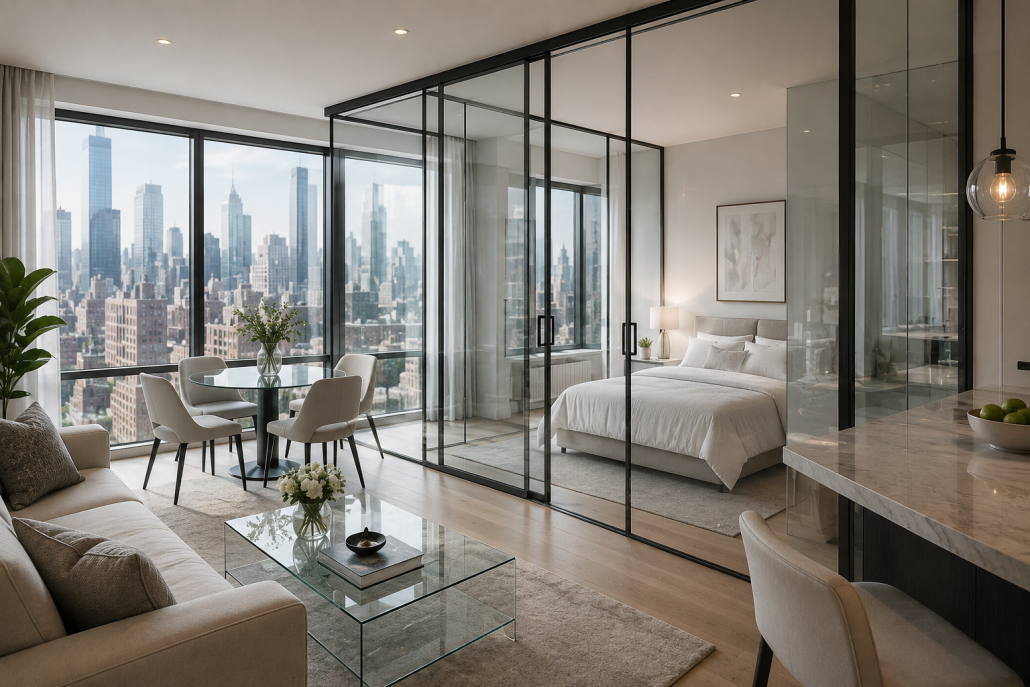
If you’ve lived in Manhattan long enough, you’ve probably stood in the middle of an apartment and wondered what exactly the original designer was thinking.
Maybe it’s a West Village studio where the bed somehow ends up visible from every angle. Maybe it’s a Murray Hill one-bedroom with a living room that feels generous until you put an actual sofa in it. Maybe it’s an Upper East Side co-op with a galley kitchen so narrow two people can’t comfortably open opposite cabinet doors at the same time.
We’ve worked in all of them. Many times.
And here’s something homeowners often discover during renovations: making a small apartment feel larger usually has less to do with knocking down walls than people think. Glass changes how light moves through a space. It changes sightlines. It changes what your brain believes about volume and distance.
But when you’re working with 600 square feet and one decent window, small visual tricks suddenly become surprisingly important.
Why Glass Works Better Than Paint, Furniture, or Lighting Alone
People often start with paint. Then furniture. Then lighting. Those things matter. But glass does something none of them can do. It manipulates light that’s already there.
In a typical Manhattan apartment, natural light usually enters from one primary direction. Maybe two if you’re lucky. Everything else is a negotiation. Glass helps that light travel farther. Mirrors reflect it. Clear glass transmits it. Textured glass diffuses it.
The result is often a room that feels more open without actually gaining a single square foot. Which, in Manhattan, would be an expensive miracle.
For more inspiration, explore our custom mirror solutions.
Full-wall mirrors: the single most effective space-expanding tool in a Manhattan apartment
If someone forced me to choose only one upgrade for a small apartment, this would probably be it. Probably.
A properly placed mirror can completely change how a room reads.
Benefits include:
- Doubles perceived visual depth.
- Reflects natural light deeper into the apartment.
- Makes narrow rooms feel wider.
- Improves brightness without additional electrical work.
- Works especially well opposite windows.
One thing worth mentioning: a mirror doesn’t create space. It creates the feeling of space. Oddly enough, your brain treats those two things as surprisingly similar.
Glass partitions instead of drywall: divide without darkening
This is one of the smartest upgrades for studio apartments.
A traditional wall solves one problem and creates another. Privacy increases. Light decreases. Glass partitions let you split functions while keeping visual openness.
Particularly useful for:
- Studio apartment sleeping areas.
- Home office corners.
- Loft-style layouts.
- Open-plan renovations.
Many homeowners researching glass partition studio apartment Manhattan projects are trying to create separate zones without making the apartment feel chopped into little boxes.
Glass is often the answer. Or at least part of it.
Room-by-Room: The Best Glass Applications for Tight Manhattan Layouts
Different rooms have different challenges. The solutions tend to follow.
The kitchen: back-painted glass backsplash adds depth and bounces light
Galley kitchens are practically a Manhattan tradition. Not necessarily a beloved tradition. But a tradition. Back-painted glass backsplashes help because they reflect light in subtle ways that tile often doesn’t.
Benefits:
- Easier to clean than grout-heavy surfaces.
- Reflects available light.
- Creates visual continuity.
- Makes narrow kitchens feel less enclosed.
- Available in custom colors.
Homeowners searching “glass ideas small NYC apartment renovations” online often overlook the kitchen entirely. They shouldn’t.
Small visual improvements become surprisingly noticeable in compact spaces.
The bathroom: frameless shower enclosure removes the visual barrier
Bathrooms suffer from visual interruptions.
Curtains. Frames. Metal tracks. Bulky enclosures. Every element cuts the room into smaller pieces. Frameless glass eliminates many of those interruptions.
Advantages:
- Creates longer sightlines.
- Makes floor area appear continuous.
- Allows light to travel freely.
- Feels less crowded.
- Modernizes older bathrooms instantly.
In some bathrooms, removing the visual barrier matters almost as much as the actual square footage.
Sometimes more.
The living room: a mirrored feature wall that doesn’t look like a gym
People hear “mirror wall” and immediately imagine a night club or a gym from 1987. That’s not what we’re talking about.
Modern mirrored feature walls are usually more subtle. Much more subtle.
Good designs often include:
- Large-format mirror panels.
- Minimal seams.
- Strategic placement opposite windows.
- Integrated architectural details.
A properly designed mirror wall small apartment NYC installation should disappear into the room rather than announce itself. The best ones are noticed indirectly. People walk in and simply think the room feels bigger.
The hallway: full-length mirror panel that doubles perceived length
Hallways are strange spaces. You move through them constantly but rarely think about them until they’re too narrow. A full-length mirror panel can dramatically change how a corridor feels.
Benefits:
- Increases perceived length.
- Brightens dark passageways.
- Reflects adjacent rooms.
- Reduces tunnel-like feeling.
Particularly useful in prewar layouts where hallways seem to exist mostly because architects enjoyed hallways.
The home office corner: frosted glass partition that signals separation without blocking light
Remote work changed apartment layouts. Or maybe exposed their limitations. Either way. Many Manhattan apartments now need dedicated work areas that were never part of the original design. Frosted glass partitions help create separation without creating darkness.
Advantages:
- Maintains privacy.
- Preserves daylight.
- Defines workspace boundaries.
- Feels lighter than drywall.
- Works in both rentals and owned units.
Many open plan ideas for small space NYC renovations now include some version of this solution.
What to Avoid: Glass Mistakes That Make Small Spaces Feel Smaller
Not every glass upgrade helps. Some actually work against the goal. We’ve seen apartments spend a surprising amount of money becoming visually smaller. That’s always a little painful.
Common mistakes include:
- Heavy mirror frames that interrupt reflections.
- Dark smoked glass in already dim rooms.
- Excessively etched panels that block too much light.
- Small decorative mirrors instead of larger panels.
- Reflective surfaces placed opposite cluttered areas.
- Dividing spaces too aggressively.
This last point matters. A lot. If a mirror reflects chaos, it doesn’t create spaciousness — it creates twice as much chaos. And your eye notices.
For additional design guidance, explore our custom glass design services.
Conclusion
When people ask how to make small apartments look bigger, they’re often expecting a complicated answer. Usually it isn’t.
The apartments that feel larger tend to do three things well:
- Maximize natural light.
- Extend sightlines.
- Reduce visual barriers.
Glass happens to help with all three. That’s why it shows up repeatedly in successful NYC small space interior design projects. Not because it’s trendy. Because it works.
A mirror catches daylight from a single window and pushes it deeper into the apartment. A glass partition separates space without sacrificing openness. A frameless shower enclosure removes visual interruptions. Small changes. Sometimes surprisingly large results.
Especially in Manhattan, where every square foot already works very hard.
FAQ
Do large mirrors make a small apartment look bigger or just reflect clutter?
Both, honestly.
A large mirror can dramatically increase perceived space, but it also reflects whatever sits opposite it. Placement matters almost as much as size.
Is a frameless shower enclosure worth the cost in a small Manhattan bathroom?
For many homeowners, yes. Removing visible framing creates cleaner sightlines and often makes the bathroom feel noticeably larger.
Can a glass partition be installed in a studio apartment without drilling into the floor?
In some situations, yes. Certain systems use alternative mounting methods, though feasibility depends on the building and application.
What size mirror works best for a narrow Manhattan hallway?
Generally, larger panels create the strongest effect. Full-height installations often produce the most noticeable improvement in perceived length and brightness.
Does a glass backsplash actually make a galley kitchen feel bigger?
It can. Reflective surfaces bounce light around the room and reduce the visual heaviness that sometimes occurs with darker or heavily segmented wall finishes.


Leave a Reply
Want to join the discussion?Feel free to contribute!