
When One Eighth of an Inch Changes Everything
An eighth of an inch sounds almost comically small. Ignore it while hanging a picture? Probably. Building a deck? It might not even raise an eyebrow. But bring that same tiny fraction into the world of custom glass and suddenly it becomes the loudest number in the room.
People often expect installers to make little adjustments on installation day, the way a carpenter trims a board or shaves a door that swells during a humid summer. Glass doesn’t play that game. By the time a custom panel arrives at your home, every edge has already been cut, every hole drilled, every corner polished, every decision quietly locked into place.
That’s why experienced installers spend so much time measuring before production even begins. They’re not delaying the project. They’re protecting it from all sorts of mistakes, including the one that’s only one eighth of an inch wide.
Why Glass Doesn’t Forgive Measurement Errors
Construction is surprisingly forgiving. Wood can usually be trimmed. Metal brackets sometimes allow a little adjustment. Drywall hides all sorts of tiny imperfections behind paint. Even tile installers occasionally have a clever solution tucked away somewhere between experience and stubborn optimism.
Glass is different. Remarkably different.
Every custom panel begins as raw glass that is carefully cut to its final dimensions before anything else happens. Openings for hinges, handles, clamps, or mounting hardware are drilled while the material is still workable. Edges are polished until they’re smooth enough to touch comfortably. Every little notch, every corner, every curve already exists before the panel moves into tempering.
Then everything changes.
The tempering process transforms the glass into a much stronger safety material, but it also ends the conversation about modifications. No trimming. No drilling another hole because someone changed the hardware. No removing “just a little” from one edge because the wall leaned more than expected.
There isn’t a secret trick professionals save for emergencies. There isn’t a magical saw hidden in the truck. Installation day isn’t the moment when the glass is made to fit. Installation day is the moment everyone discovers whether it already does.
Where a Small Error Creates Big Problems
Tiny measurement errors begin quietly.
A shower door brushes against the curb every time it closes. Nothing special at first. Just a faint little touch. Weeks later the homeowner starts wondering why the door never feels quite right.
A reveal gap looks perfectly even on one side, then slowly widens toward the top like it has somewhere else to be. Hinges refuse to align naturally because one mounting point drifted only a couple millimeters from where it belonged. Hardware that looked beautifully centered on the drawings suddenly feels awkward once it’s installed beside real walls instead of imaginary straight ones.
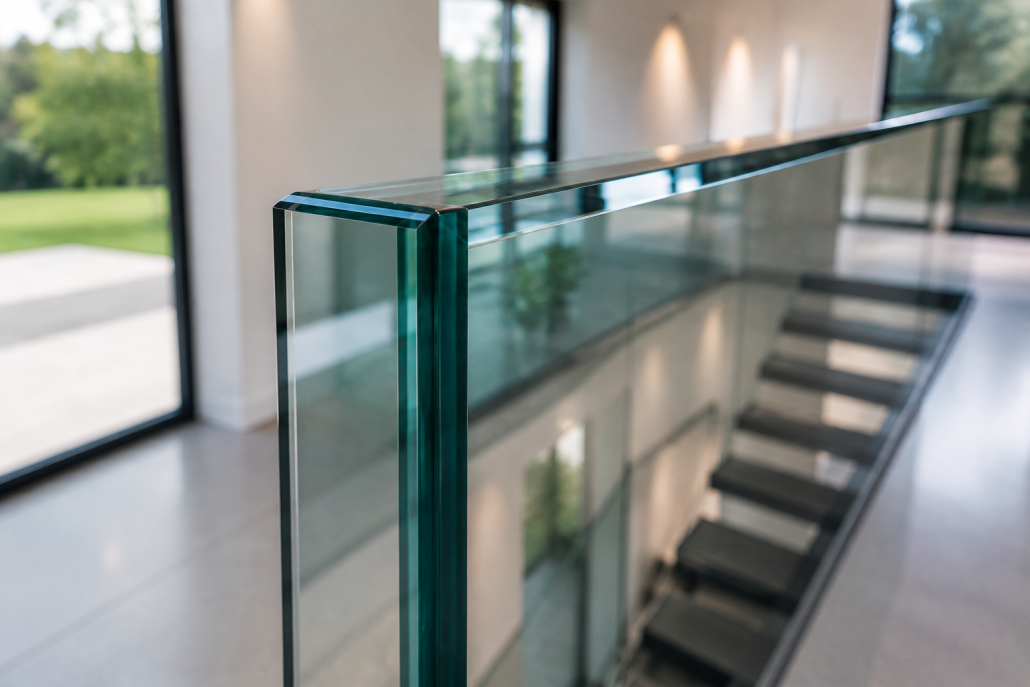
Glass railings tell similar stories.
Panels that should meet seamlessly leave tiny inconsistencies where every reflection quietly exaggerates them. Mirrors sometimes reveal unexpected gaps along uneven walls, making a custom installation look strangely unfinished despite flawless craftsmanship.
Glass has an almost unfair ability to expose geometry. Paint disguises. Caulk softens. Trim distracts. Glass simply tells the truth, though. Sometimes a little louder than anyone expected.
Every Product Has Different Tolerances
Not all custom glass asks the same questions.
A frameless shower door spends its life swinging open and closed, so hinge placement, door clearance, and consistent spacing become incredibly important. A difference that barely matters on another project may suddenly affect how the entire enclosure feels every single morning.
Glass railings think differently. Their priority isn’t just alignment but continuity. One panel naturally leads the eye toward the next, so subtle dimensional changes can interrupt lines that should feel almost effortless.
Glass partitions introduce another set of challenges. Doors must operate smoothly. Hardware needs to line up across multiple panels. Reflections have a curious habit of emphasizing anything slightly out of rhythm.
Mirrors are deceptive.
People assume they’re simple because they don’t move. Yet walls rarely remain perfectly flat across their entire height, and a custom mirror has no interest in pretending otherwise. Even floating glass shelves have their own expectations, balancing structural support with clean visual proportions that leave very little room for casual measuring.
It’s almost like every project speaks a different dialect. They’re all saying “precision.” They’re just pronouncing it differently.
How Professional Measurements Prevent Expensive Mistakes
Watching an experienced installer measure a room can feel strangely uneventful. Then you notice they keep checking the same area.
Again. And again. There’s a reason for that.
Laser measuring equipment captures dimensions with extraordinary accuracy, but numbers alone rarely tell the whole story. Walls are checked for plumb because they have an unfortunate habit of leaning ever so slightly after years of supporting a building that has quietly settled into the earth. Floors are checked for level because gravity never takes a day off. Hardware locations are reviewed carefully to ensure handles, hinges, brackets, and clips all have the space they need—not approximately, but exactly.
Templates may be created for unusual openings. Complex angles receive additional attention.
Every critical dimension is verified before fabrication begins because discovering a discrepancy while standing in a bathroom with a tape measure is infinitely preferable to discovering it after an expensive sheet of tempered glass arrives from the factory.
Measurements become drawings. Drawings become production. Production becomes glass. Changing the order isn’t really an option.
Precision Isn’t About Perfection—It’s About Performance
People hear the word “precision” and sometimes imagine obsessive perfectionism. The sort of person who straightens picture frames in hotel rooms. That’s not really what’s happening here.
Precision isn’t about chasing impossible mathematical ideals inside buildings that have been settling, expanding, shrinking, and quietly changing for decades. It’s about making sure the finished glass performs exactly as intended.
Glass doors should swing effortlessly instead of hesitating halfway through their travel. Panels should meet with clean, consistent gaps that feel intentional rather than accidental. Hardware should align naturally because it was planned around the room that actually exists, not the one someone wished existed on paper.
Appearance matters. Operation matters even more. Longevity quietly depends on both.
And safety? Safety begins with measurements long before anyone lifts the first glass panel into position. It’s curious how the smallest fractions often carry the biggest responsibilities. One eighth of an inch doesn’t seem like much while you’re holding a ruler. Inside a custom glass project, though, it can quietly decide whether everything that follows feels effortless—or becomes a story nobody wanted to tell.
Ready to Start with the Right Measurements?
The smoothest custom glass installations begin long before production, delivery, or installation day. They begin with careful measurements, thoughtful verification, and enough patience to check the details before glass ever enters production.
If you’re planning a frameless shower enclosure, custom mirror, glass railing, partition, shelving, or another architectural glass feature, schedule a professional site measurement before placing an order. It’s the least noticeable part of the project when it’s done well—it’s also the part that influences everything else.
FAQ
How accurate do custom glass measurements need to be?
Very accurate. Even differences of a few millimeters can affect door operation, hardware alignment, edge clearances, and the overall appearance of a finished installation.
Can glass be trimmed if the measurements are wrong?
No. Once tempered, custom glass cannot be cut, drilled, shaved, or otherwise modified. Incorrect measurements usually require an entirely new panel.
Why do installers measure more than once?
Because verification prevents expensive mistakes. Multiple measurements help confirm dimensions, identify irregular walls or floors, and ensure fabrication is based on accurate information.
Are laser measurements more accurate than tape measurements?
Laser measuring systems provide exceptional precision and consistency, especially for complex openings. Experienced installers often combine laser measurements with manual verification to ensure every critical dimension is correct.
Why can’t custom glass be adjusted during installation?
Unlike wood or other building materials, tempered glass has already been manufactured to its final dimensions before it arrives on site. Installation is about fitting the correctly fabricated panel into place—not altering the panel to fit the opening.


Leave a Reply
Want to join the discussion?Feel free to contribute!