
Frameless Glass Doors: Right for a NYC Home?
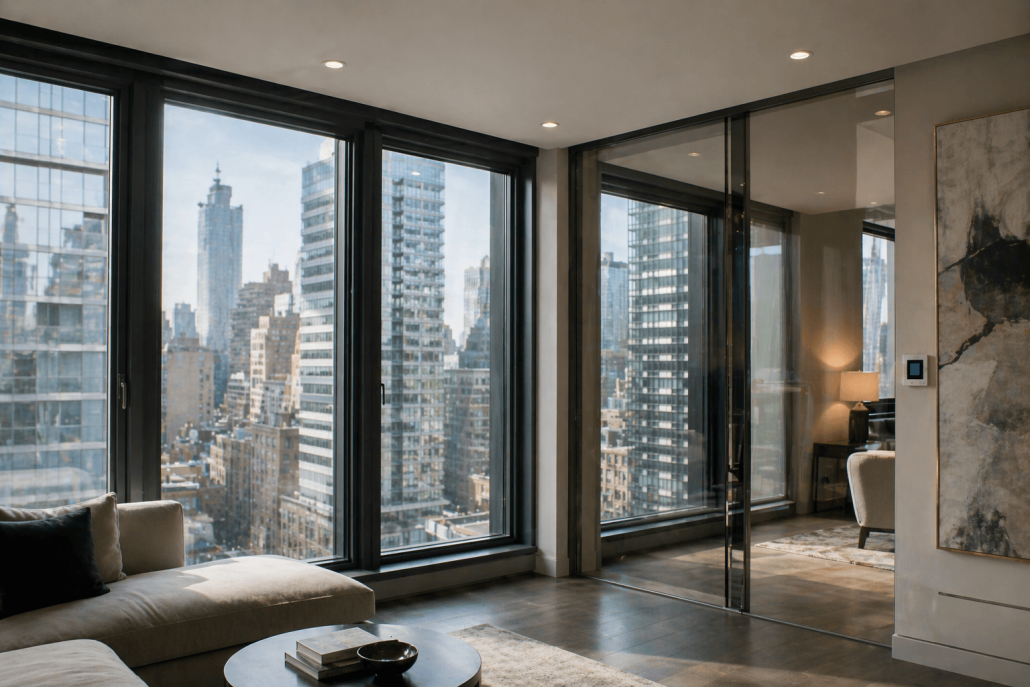
Picture a small New York apartment with a room that doesn’t have a window.
Maybe it’s an office squeezed into the corner. Maybe a closet that somehow became a bedroom-adjacent storage disaster. The lights are on, but the room still feels like a box.
A frameless glass door can change that.
It won’t make the apartment bigger. Nothing short of knocking down a wall will do that, and your co-op board likely has opinions about that. But glass lets borrowed light travel through the apartment while keeping the rooms physically separated.
For many NYC homes, that’s exactly the point.
Key Takeaways
- Frameless glass doors can make small apartments feel more open without removing the separation between rooms.
- “Frameless” doesn’t mean flimsy, the glass and hardware have to be selected for the size and application.
- Privacy and sound control are the real trade-offs. Clear glass gives you light, but it also gives you visibility.
- In a co-op or condo, check the building’s alteration rules before ordering anything. NYC also has specific safety-glazing requirements for glass doors.
Defining “Frameless”
It doesn’t mean the glass is hanging in midair.
There is still hardware—hinges, clamps, handles, tracks, seals, or other fittings, depending on whether you’re looking at a swing or sliding configuration. What you’re getting rid of is the bulky perimeter frame that normally surrounds the glass.
That changes the feel of the room immediately.
The glass becomes the door, rather than just a panel set inside a frame. Also, since there’s less visual material around it, the glass itself has to do more of the work. Frameless installations typically use thicker safety glass than ordinary household window glass, with the exact specification depending on the size, configuration, hardware, and application.
At Glass Factory, we fabricate and install custom glass doors and work with both swing and sliding configurations. The measurements, hardware, and wall conditions all matter – a lot. The wall it’s being attached to matters quite a lot.
Glass is unforgiving.
Measure twice. Then measure again.
Where Does a Frameless Glass Door Actually Make Sense?
This is where NYC apartment layouts really vary.
A Small Home Office
You’ve got a desk in a corner, a laptop, two chargers you can’t identify, and somehow six feet of valuable floor space disappearing behind a conventional door.
A glass door can separate the office without making it feel like you’ve built a little cubicle.
Clear glass keeps the room visually connected. If you need more privacy, there are frosted, tinted, textured, or other glass options.
A Closet or Dressing Area
A frameless glass door can give a walk-in or dressing area a cleaner appearance while letting light into a space that might otherwise need its own fixture running all day.
Sliding glass can be especially handy where there’s simply no room for a door to swing.
That’s New York math. Every six inches has a job.
A Bathroom or Shower
This is probably the most familiar application. Frameless shower enclosures remove the heavy visual frame around the glass and make a small bathroom feel less chopped up.
They’re also easier to clean than framed constructions where moisture and grime can collect around the frame.
A Balcony or Exterior Door
This requires more careful planning than an interior room divider because you’re dealing with exterior conditions, hardware, building requirements, and potentially much larger glass panels.
It can be beautiful. It can also become a much more complicated project than a simple interior door.
That’s where you want an installer looking at the actual opening rather than somebody selling you a picture from Pinterest. Feel free to learn more about what we offer if you’re looking for swing and sliding options.
The Part Nobody Brags About Online
Frameless glass looks fantastic.
It also has trade-offs.
Privacy is the obvious one. Clear glass doesn’t care if you’re having a private conversation. If the room needs visual separation, you may want frosted, textured, tinted, or switchable glass instead.
Sound is another issue. A glass door doesn’t magically become a soundproof wall. If you’re trying to keep your kids’ gaming session out of your Zoom call, frameless clear glass probably isn’t the miracle you’re hoping for. Framed or laminated systems can provide different acoustic performance, depending on the design.
Then there’s cost.
Custom glass is not the bargain-bin version of a hollow-core door. You’re paying for measurement, fabrication, finishing, hardware, transportation, and installation, along with the glass itself.
But you’re also getting something made for that particular opening.
In a Manhattan apartment where nothing is quite square and every wall seems to have a story, that matters. Quite a lot.
One More Thing: Your Building May Have a Say
Before ordering a wonderful glass door, check with building management.
Seriously.
Co-op and condo buildings can have their own alteration procedures, insurance requirements, work-hour restrictions, and approval processes. Co-ops commonly require an alteration agreement and board approval for interior renovation work, while condo requirements can vary by building.
In other words, don’t schedule the installer first and ask the board later. That is how a simple door turns into a surprisingly annoying project.
And there’s the NYC Building Code.
Under current NYC Building Code Section 2406.4.1, glazing in the fixed and operable panels of swinging, sliding, and bifold doors is considered a hazardous location, subject to specified exceptions. Safety glazing in hazardous locations must meet the applicable impact requirements, and safety-glazing panes have identification requirements under Section 2406.3.
So no, you don’t just pick whatever piece of glass looks nice and put hinges on it.
The glass needs to be appropriate for the application.
We’ve seen enough installations to know that the boring part – the glass specification, hardware, measurements, building rules – is usually more important than the photograph that made you want the door in the first place.
A Friendly Reminder
A frameless glass door can make a NYC apartment feel noticeably less boxed in, especially where natural light is already in short supply. But the clean look doesn’t mean the installation is simple. Glass thickness, hardware, wall conditions, privacy, sound, and building rules all matter.
Sometimes clear glass is the right answer. Other times, frosting makes more sense. And sometimes the door you pictured simply isn’t the best fit for the opening. That’s where careful measurement and an experienced installer earn their keep.
If you’re considering a swing or sliding configuration, Glass Factory’s services is a good place to start.


Leave a Reply
Want to join the discussion?Feel free to contribute!