
Smoked, Frosted, or Switchable: Choosing Privacy Glass for a NYC Apartment or Office
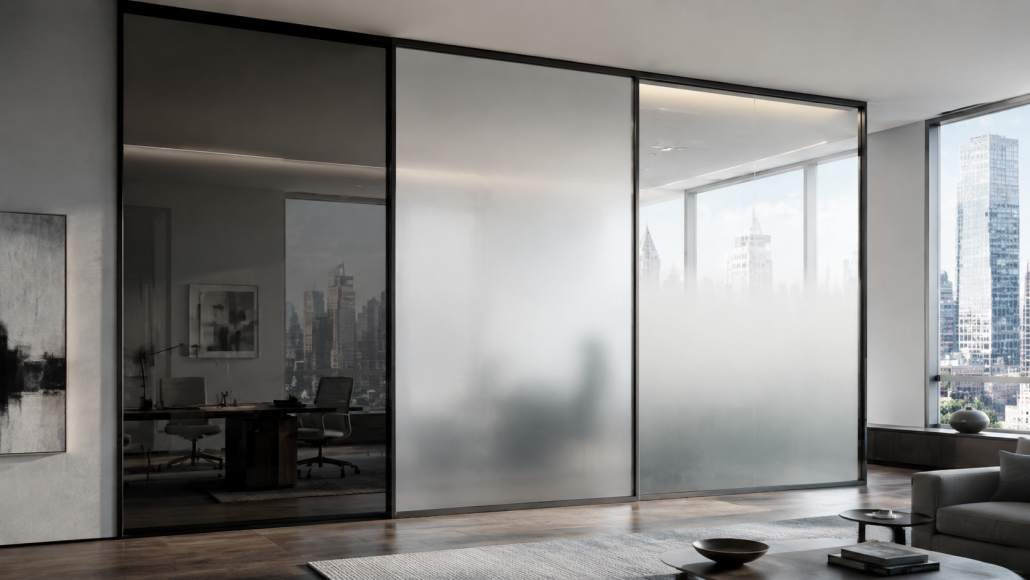
You’re sitting in your glass-walled home office, looking across the airshaft at the building opposite, and suddenly you have a thought: “Can they see me?”
Maybe they can. Maybe they can’t. Either way, once you’ve thought about it, you’re probably going to keep thinking about it.
The same thing happens in offices. A facilities manager walks past a glass conference room and realizes the entire meeting is visible from the hallway. The glass looks great. Privacy doesn’t.
That’s where smoked, frosted, and switchable glass come in. They all change what you can see through glass, but they do it differently. Choosing the right one is not merely about which finish looks coolest.
It’s about what you need the glass to do.
Key Takeaways
- Smoked glass darkens the view while keeping some transparency.
- Frosted glass diffuses the view and gives more consistent visual privacy.
- Switchable glass changes from clear to opaque when privacy is needed.
- Cost, sound, maintenance, building approval, and NYC safety requirements all belong in the conversation before the glass is ordered.
Smoked, Frosted, or Switchable?
Start with smoked glass.
Think of it like sunglasses, but for your wall.
Smoked or tinted glass reduces light transmission and makes whatever is behind it harder to see clearly, depending on the darkness of the tint. You still have transparency, though. Someone standing on the other side may remain visible. All that can be useful when you want a little separation without completely closing off the room.
Frosted glass works differently.
Instead of simply making the glass darker, the finish scatters light. Shapes and movement can still be visible, but details become blurred. You might know somebody is standing behind the door. You shouldn’t be able to study their facial expression from the hallway.
For bathrooms and interior offices, that’s often enough.
Then there is switchable glass; this option is unique. Depending on the system, electrical current switches the glass between transparent and opaque. Clear when you want the room open. Private when you don’t. The glass becomes the door, rather than just a panel set inside a frame.
It’s a very different proposition. You’re not choosing permanent privacy. You’re choosing when privacy happens.
Where Does Each One Make Sense?
Take a bathroom door. Frosted glass is usually the uncomplicated answer. You get light without turning the bathroom into a fishbowl.
A home office is less obvious. This is where NYC apartment layouts really vary. Maybe you want the room to feel connected to the rest of the apartment, yet prefer that people walking past cannot read your monitor. Frosted glass gives you privacy without building another solid wall. Smoked glass can work if you want more visual connection and don’t need complete obscurity.
For a conference room, switchable glass starts making a lot more sense. Clear during normal work. Opaque when the meeting gets confidential.
No blinds to yank down. No curtains. No one wandering past and trying to read the presentation upside down.
A street-facing storefront can go another direction. Smoked or tinted glass can reduce visibility and glare while still bringing daylight into the space. Whether that’s useful depends on the business. A display window and a private office have very different jobs.
Glass Factory offers frosted, tinted, and switchable glass options as part of its custom partition work. Reach out and check what we offer.
Then There’s the Small, Dark NYC Apartment
Imagine an interior room with no windows. Maybe it started as an office nook. Maybe it’s a little dressing room. maybe someone decided a corner of the apartment could become a “guest room”—a quintessentially New York exercise in optimism.
A solid door gives privacy but blocks whatever light might have reached the space. Clear glass does the opposite. Privacy glass sits somewhere in between. Nothing short of knocking down a wall will do that, and your co-op board likely has opinions about that.
And if you pair it with a frameless door, you can keep the whole thing visually lighter.
“Frameless,” by the way, doesn’t mean there’s no hardware. There are still hinges, handles, clamps, tracks, seals, and whatever else the particular configuration requires. What disappears is the bulky frame around the perimeter.
It involves much more than simply attaching hinges to standard window glass.
Where Frameless Privacy Glass Earns Its Keep
An office nook is an obvious candidate. You get separation without making a small apartment feel even smaller.
A closet or dressing area can benefit from the same approach, particularly if there’s barely enough floor space to walk around without adding a swinging door.
A shower is another common application. Frosted or textured glass gives privacy while still letting the bathroom breathe visually.
The balcony door deserves specific consideration.
That one deserves more thought because exterior doors bring additional concerns—weather exposure, hardware, building requirements, opening size, and the rest of the usual New York fun.
Feel free to check the custom swing and sliding configurations we offer.
The Trade-Offs Are Real
Privacy glass isn’t magic.
- Privacy: Frosted glass generally gives more visual privacy than smoked glass. Switchable gives you control, but only when you actually use the system.
- Sound: None of these automatically makes a room soundproof. Glass construction matters. So do seals, gaps, the surrounding wall, and the door itself. If your goal is stopping every word from escaping a conference room, that’s an acoustic design problem—not simply a glass-finish problem.
- Cost: Smoked and frosted glass are relatively straightforward. Switchable glass is more involved because you’re adding an electronic system to the glass. Custom sizing, hardware, installation, and access can all affect the price.
Maintenance is straightforward.
The glass generally gets cleaned like other architectural glass. Frosted surfaces can show fingerprints or cleaning residue more readily, depending on the finish. Switchable systems add electrical components, so there’s simply more to the installation than a piece of glass and a squeegee.
Before You Order: Ask the Building
This gets skipped surprisingly often.
If you’re in a NYC co-op or condo, check the building’s alteration rules before ordering custom glass. Buildings can have their own approval procedures, contractor requirements, insurance requirements, work-hour restrictions, and board or management review.
Recent NYC guidance has also reinforced the role of co-op and condo boards in certain renovation filings.
Better to find that out before fabrication.
Also, there’s the NYC Building Code. Under Section 2406.4.1, glazing in fixed and operable panels of swinging, sliding, and bifold doors is generally considered to be in a hazardous location, subject to the code’s listed exceptions. Safety glazing also has to meet applicable impact requirements.
In plain English: the glass used in a door isn’t just a decorative choice—it has to be the right glass for the application.
A Friendly Reminder
There is no single ideal privacy glass type for every NYC apartment or office. Smoked glass, frosted glass, and switchable glass each solve a slightly different problem. The right choice depends on whether you need to soften visibility, block it, or control it when necessary.
Then come the less glamorous questions—sound, maintenance, hardware, building approval, safety glazing. Those details tend to matter more once the glass is actually installed.
If you’re unsure which direction makes sense for your space, Consulting with Glass Factory is a good place to start. Glass Factory can walk through the options with you and figure out what fits the room rather than forcing the room to fit the glass.


Leave a Reply
Want to join the discussion?Feel free to contribute!